
On Reading Heidegger
Hermeneutic Cyclicality in "The Origin of the Work of Art" (1935, 1950).

In preperation for a BA Seminar on “Close Reading: Theory & Practice” I intend to give at the RUB this coming semester, I’ve been going back through some of my own work as a student. The following is a slightly edited paper I wrote way back in 2012 for a class given by Laura Bieger at the John F. Kennedy Institute of the Freie University Berlin. I’m considering using it as a model for student discussion.
On Reading Heidegger
By Lee A. Flamand
Introduction
Heidegger is a notoriously difficult philosopher to read. His wordplay and hermeneutic style of argumentation notwithstanding, even getting a grip on the simple sense of what Heidegger wants to say can be difficult at times. This is, of course, intentional; stylistic opacity forces us to work towards the excavation of a meaning which is never fully disclosed, and is therefore never exhausted. Heidegger’s texts, in many ways, play the same role as the concept of earth in his essay “The Origin of the Work of Art”—they conceal. “The Earth is essentially self-secluding. To set forth the earth means: to bring it into the open as the self-secluding” (25). Thus, we encounter the first step towards formulating our reading of Heidegger’s work: bringing into the open and explicitly recognizing the resistant, self-secluding nature of the text, and taking seriously the difficulty and opacity with which we come into contact with it. In other words, we must understand that, no matter how many times we may have grappled with it, we have not yet fully disclosed it to ourselves: “the truth that opens itself in the work can never be verified or derived from what went before. In its exclusive reality, what went before is refuted by the work” (47). The resistance of Heidegger’s style to the full disclosure of meaning is thus part-and-parcel of his argument; it constructs a hermeneutic engine of recursive self-revealing and self-concealing, much as the work of art itself enacts a dramaturgy of disclosure and withdrawal. Like the work of art, Heidegger’s thought unfolds precisely by folding back in on itself, thus clearing out space for the perpetual self-disclosures of the work-as-world(maker) through the inexhaustible resistance of the text-as-earth.
Stylistic opacity forces us to work towards the excavation of a meaning which is never fully disclosed, and is therefore never exhausted.
Where, then, do we situate the work of reading in Heidegger’s thinking? What follows is an attempt to tease out what the meaning of reading might be in the ontological phenemonology of Heidegger’s thought. I attempt to bring out this meaning by reading “The Origin of the Work of Art” so as to disclose the ways in which it continually folds back in upon itself: the way in which, in other words, it discloses itself precisely to the degree in which it closes itself back off. This requires that we take the central claims of “The Origin of the Work of Art” seriously; in other words, we presume from the get-go that “The Origin of the Work of Art” is itself a work, ontologically comparable to the work of art, and therefore should be read on and in its own terms. Already “it is easy to see that we are moving in a circle” (2) when taking such a position on the ontological status of Heidegger’s essay. Staying true to this position will require a reading which is itself an opening up of the text to itself: a coming-into-being of the reading through the work, if you will. What does that mean? It means we never approach Heidegger’s work with the assumption that we already know it. With each reading, the text reveals itself to us before withdrawing back into concealment; it discloses something (a)new, teaching us how to read it all over (and over) again. (A proposal for a definition of misreading: to suppose that we know in advance that which we will come to uncover.)
The Text-as-Earth and the Worlding of the Work-as-Reading
With each reading, getting a grip on Heidegger requires work: “to be a work means: to set up a world” (22). One must work one’s way through Heidegger’s text in order to disclose it, to bring its world out into ever-new light. This work, like the work of art, produces a world, which becomes at once a verb and noun: “World worlds” (23). The work we do in disclosing Heidegger to ourselves is the process of clearing, illuminating a world-as-reading from the darkness of the text-as-earth. What our exploration reveals is itself a work – or what we may more familiarly refer to as a reading. Such a reading plays the role of disclosing the being-of-the-work to us—and by extension, to itself.
To begin to penetrate the darkness of Heidegger’s text, we can begin where he begins: “we must move in a circle… every individual step that we attempt circles within this circle” (2). We must also begin by asking similar questions of our own activity as Heidegger asks of the work of art: what is a reading and what is a text? A reading necessitates a reader, and a reader needs a text to read. Moving in this circle, we quickly see that the formulation of our question mimics that of the artist: art, artist, and the artwork are analogous to reading, reader, and text. To ask the question, “what kind of a thing is a text?” will bring us to the obvious answer: that which is read by a reader. Soon we see that this gets us nowhere; to begin to read this text, we must recognize that it is “something over and above” its textliness, just as the artwork is something more than its thingliness: “it is an allegory” (3).
What kind of allegory? I have already suggested that the text is an allegory for the earth, while we may see the work which develops from the text (in a word, the reading) as an allegory for the work of art. But this seems too simple. We do not want to reduce the essay to a mere figure, much as we are tempted to reduce the artwork to a mere symbol. The text and the work are more than mere rhetorical figures; far from being a mere allegory, the ontological status of the text is that of the earth, in that it initially conceals itself, resisting disclosure. Moreover, the work unfolds from the text – it worlds itself in the process of our reading. The question is, how? And what is the ontological status of reading in this worlding of the work from the text-as-earth?
We have already noted that the text resists our reading much in the same way as Heidegger’s conception of earth resists our understanding. But what, for Heidegger, is earth? “Earth is that in which the arising of everything that arises is brought back” (24). Our understanding relies upon the earth; however, this understanding is fleeting, as the earth always closes back in on itself. Such is true of the text, as well. Moments, glimmers of understanding begin to form, and for awhile we begin to understand its meaning. However, this understanding is never exhausted; we never hold it in its entirety or possess it as a final totality. The earth resists mastery, and thus sinks back into itself. What does it mean for this meaning to be “brought back” to the earth? “Earth is the coming-forth-concealing. Earth is that which cannot be forced, that which is effortless and untiring” (24). We begin to understand the earth through our understanding of its consistent concealment. We grapple with it for meaning, but it will not be forced to disclose its truth so easily. We understand it precisely as this resistance. So earth is that which lets itself be known by means of its resistance to our understanding; it is in our struggle to make sense of the earth that we know it. Such is true also of our reading of the text.
A proposal for a definition of misreading: to suppose that we know in advance that which we will come to uncover.
“On and in the earth, historical man founds his dwelling in the world. In setting up a world, the work sets forth the earth” (24). Here, Heidegger introduces us to another term: world. To understand better the earth, that place on and in which we set up our worlds, we must locate our home in that which is not the earth. This home is a world. What, then, is a world? “World is never an object that stands before us and can be looked at. World is that non-objectual to which we are subject as long as the paths of birth and death, blessing and curse, keep us transported into being” (23). The text, then, cannot be a world; the world must subsist in the meanings in which we find ourselves and negotiate Dasein, our being-in-the-world. It must be a work. The world is not purely physical; it cannot be an object for mere empirical investigation. The minute we make it so, it withdraws from us, and like a stone it becomes “world-less” (23), losing its greater significance.
“World and earth are essentially different and yet never separated from one another. World is grounded on earth, and earth rises up through world. But the relation between the world and earth never atrophies into the empty unity of opposites unconcerned with one another” (26). World and earth are shot through with one another, interdependent and interrelated. We must have a world (indeed, we are always already thrown into a world), because the world is essentially that which makes us human. It is by virtue of our being-in-the-world that we locate ourselves as human agents and historical “subjects” (Heidegger would prefer the term Dasein) – friends, fathers, daughters, workers, students, etc. – the “homes” in which we dwell. However, the world is grounded upon the earth, which consists of the things we don’t notice but are always there: the ground beneath our feet, the air we breathe, and the history from which we emerge.
If earth is our history, then world is our destiny: where we will go, what we will do, the plans we make and the things we are actively trying to become. In the earth we find the necessary conditions for our existence and ultimately, we return to it (our demise being, after all, the necessary outcome of our existence); in world, we find ourselves completely absorbed in purposes, desires, habits and obligations – we move forward, comport ourselves purposefully towards our ends (in both senses of the word). It is here, in the world, where we try to negotiate for ourselves that which will have been the meaning of our lives. Once that meaning is realized in the finality of our experiences (our death) we descend back to the self-concealing earth.
Where do we locate ourselves as readers of Heidegger’s text within this system? If the text is that from which our reading emerges (and ultimately that which persists after the reading has terminated – which is to say, has achieved the meaning of its “life”), then the text is initially of the earth. Our reading discloses this text to us, and allows us to negotiate meaning within it; we come to dwell in it. This interaction, the development of meanings within the worlding which is our reading of the text-as-earth, wrenches Heidegger’s work free from it: “the work-being of the work consists in fighting the fight between world and earth. It is because the strife reaches its peak in the simplicity of intimacy that the unity of the work happens in the fighting of the fight. The fighting of the fight is the continually self-surpassing gathering of the agitation of the work” (27). The “work-being of the work” opens up the struggle between world and earth. This allows us to come to greater and greater understanding of a work through this struggle, which is ever self-surpassing (though never “Transcendental” in the totalizing or omniscient sense). In this struggle, which is also a becoming-intimate with the text, a world – meanings, purposes, thoughts – emerge as the text gives way to the work, and our reading-as-work (for were they not, ultimately, always already the same?) comes into being. However, this struggle is not merely violent – a wrenching free, a cracking open, or a breaking in – but rather a process of becoming accustomed to it, of inhabiting the terms of the work, learning to dwell within its world as we become intimate with it. Reading is not a stealing-from or beating-out, but rather a residing-in which illuminates a work.
Our reading discloses this text to us, and allows us to negotiate meaning within it; we come to dwell in it.
So now we have seen how Heidegger’s work unfolds itself at once – and at one – with our reading of it, generated in the tension between the earthliness of the text and the worldliness of the work-as-reading. We begin, in our dwelling in the work, to forge an intimacy with it, and thus to better understand it. However, the moment we think that we have moved forward, we come to realize that the work has brought our reading in a circle, and it begins again to close in on itself. We have recognized the essential identity of the work and its reading; however, we have not yet been able to reconcile all of this with Heidegger’s primary concern: the meaning of the being of the work of art. How does our reading of this work, “The Origin of the Work of Art”, relate to Heidegger’s account of the work of art?
Reading (and) the Work of Art
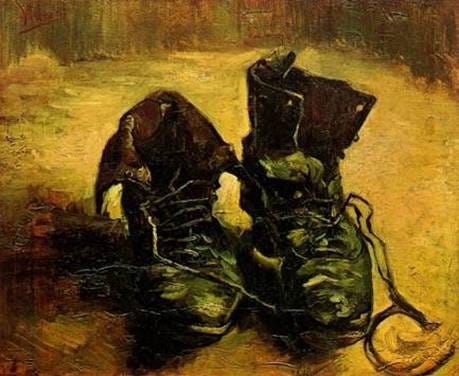
Let us move forward by reading Heidegger as he reads the work of art (again, already, the circle has emerged). I will focus on Heidegger’s reading of Vincent van Gogh’s A Pair of Shoes (1885/6). Heidegger eases his way into the discussion of van Gogh’s painting through a discussion of serviceability and equipment. The being of equipment is its serviceability, which means that it is crafted to fulfill a purpose: “a being that falls under serviceability is always the product of a process of making. It is made as a piece of equipment for something” (10). However, equipment also shares “an affinity with the artwork in that it is something brought forth by the human hand… it is half artwork” (10). Equipment is crafted in the image of its purpose, and this means that it has a human meaning. Furthermore, it is set forth by the human hand from the material from which it is made, not unlike the work of art. This differentiates it from the “mere thing,” which simply sits and confounds human purposes and intelligibility. “The artwork, however, through its self-sufficient presence, resembles, rather, the mere thing which has taken shape by itself and is never forced into being” (10). This is not to say that the artwork has no meaning; rather, we seem not to associate it with its human origins – it seems self-sufficient, self-authored, as if the human hand merely discovered it and freed it from its material. I propose to move forward by reading Heidegger as he reads the work of art (again, already, the circle has emerged). I will focus on Heidegger’s reading of Vincent van Gogh’s A Pair of Shoes (1885/6). Heidegger eases his way into the discussion of van Gogh’s painting through a discussion of serviceability and equipment. The being of equipment is its serviceability, which means that it is crafted to fulfill a purpose: “a being that falls under serviceability is always the product of a process of making. It is made as a piece of equipment for something” (10). However, equipment also shares “an affinity with the artwork in that it is something brought forth by the human hand… it is half artwork” (10). Equipment is crafted in the image of its purpose, and this means that it has a human meaning. Furthermore, it is set forth by the human hand from the material from which it is made, not unlike the work of art. This differentiates it from the “mere thing,” which simply sits and confounds human purposes and intelligibility. “The artwork, however, through its self-sufficient presence, resembles, rather, the mere thing which has taken shape by itself and is never forced into being” (10). This is not to say that the artwork has no meaning; rather, we seem not to associate it with its human origins – it seems self-sufficient, self-authored, as if the human hand merely discovered it and freed it from its material. (A proposed way of evaluating one’s own writing: looking back on it to find oneself exclaiming, “did I write that?!”)
From this articulation of equipment, Heidegger performs a reading of one such a piece of equipment – which he presumes to be a peasant’s shoes – as they appear in one of van Gogh’s paintings. What we witness is not the description of a pair of shoes, nor an explication of the form and style of a painting, but rather the unfolding of a world:
From out of the dark opening of the well-worn insides of the shoes the toil of the worker’s tread stares forth. In the crudely solid heaviness of the shoes accumulates the tenacity of the slow trudge through the far stretching and even-uniform furrows of the field swept by a raw wind. On the leather lies the dampness and richness of the soil. Under the soles slides the loneliness of the field-path as evening falls. The shoes vibrate with the silent call of the earth, its silent gift of the ripening grain, its unexplained self-refusal in the wintry field. The equipment is pervaded by uncomplaining worry as to the certainty of bread, wordless joy at having once more withstood want, trembling before the impending birth, and shivering at the surrounding menace of death (14).
What passage – itself a reading! – could more demand a reading all its own? The shoes themselves organize the vast constellation of the peasant woman’s life around their mere presence. We understand from their place within the equiprimordial nexus of the woman’s life – the universe of meanings and purposes which their usefulness gathers together – the life-world within which they achieve their intelligibility. It is a world of seasons and toil, the daily trudge through the fields, the earthen soil which provides for this world’s subsistence, the yearly struggle against the whims of nature, which could refuse a bountiful harvest and tear this life-world from existence, continually renewed in births and deaths to come, all of which renders meaningful the being of the peasant woman’s everyday actions.
The meaning of the peasant woman’s shoes emerge “from out of the dark opening” of the earth itself to form a world of purposes, desires, hopes, comportments and obligations. In other words, Heidegger’s reading – always already at one with the work itself – reveals that which was already there, but concealed behind our everyday familiarity with it. It reveals the comprehensibility of the peasant woman’s world in its fundamental relationship to the earth, and it holds this vision dynamically suspended in its self-sufficiency. In this way, it dramatizes a fundamental truth of existence: the rift, the constitutive nothingness between the world and earth in which we as Dasein – those beings for which being is an issue – emerge and recede back into. The work of art discloses the truth of our own being to us. It is this disclosure which we have been referring to as a reading.
A proposed way of evaluating one’s own writing: looking back on it to find oneself exclaiming, “did I write that?!”
Reading, I mentioned briefly above, is a clearing: “the being can only be, as a being, if it stands within, and stands out within, what is illuminated in this clearing. Only this clearing grants us human beings access to those beings that we ourselves are not and admittance to the being that we ourselves are” (30). In reading the work of art, Heidegger brings this clearing to light, and we are confronted both with the earth – that which we are not, i.e. the text, which is at the same time that thing which grants us access to meaning – and in the same moment interpolated into our being. In this instance, that “being that we ourselves are” simply is our reading. To reiterate, our reading, when we are reading, is that being which we fundamentally are. The world of the text opens itself up to us in our reading, and by dwelling in it we come to grips with the meaning of our being, as we are that being which is now, at this moment, fundamentally reading. This being-reading constitutes the rift between the earth-as-text and the world-as-work. Thus, reading enacts in us and through us the work. In other words, our reading discloses to us “The Origin of the Work of Art.”
Conclusion
We have come, again, full circle. In our attempt to locate the meaning of the being of reading within the system of “The Origin of the Work of Art” we have located it simply in the work itself, locating at this focal point not only our reading-as-work, but the very being of the work as this tension between text and work which we inhabit and which constitutes both our reading as well as our being-as-reading. It is a drama which has been playing out from the beginning; such is the nature of circles. We could continue to move in its circle. However, we would never break out. Instead, we would merely extend the illuminated clearing which our reading-as-work unfolds as a world. The “Origin of the Work of Art” is as self-sufficient as the work of art. Insofar as we begin to clear a space beyond it, this space will always already be part of the world brought forth in the work of our reading.
The work of art discloses the truth of our own being to us. It is this disclosure which we have been referring to as a reading.
What are the implications of this coincidence with reading, work and the bringing-into-being of this truth? One pertains to the act of creation: “we can characterize creation as the allowing of something to come forth in what has been brought forth” (36). Our reading has revealed in this propensity to “bring forth” from that which has prior to it already been “brought forth” its fundamental creativity – the coincidence of work and reading. Reading, then, is ultimately creative. Another implication resides in “the establishment of truth in the work” which “is the bringing forth of a being of a kind which never was before and never will be again” (37). Our reading, in other words, sets forth the specificity of this moment in our being and in our reading, disclosing it as a world. This world, of course, will inevitably sink back into the (text-as-)earth, receding into history; it is in this way a constitutive yet fugitive truth, a truth which can only belong to our being once and cannot be repeated in just the same way ever again. Each reading is revealed as utterly unique.
“Concealed within itself, the beginning contains already the end” (48). As this reading terminates, receding back into the earth (where, finally, all which is Dasein must finally return), it is also already opening itself up to the next round of reading, the further unfolding of the work’s worlding towards its truth. “Every individual step that we attempt circles within this circle” (2), as Heidegger warned us from the beginning. Moving further within this truth, we trace its curve back along towards its genesis, and again we struggle to understand just what this has all really meant. All that we can be sure of is that in our next reading, this ending will have been just the beginning.
Reading, then, is ultimately creative.
Bibliography
Heidegger, Martin. “The Origin of the Work of Art.” Off the Beaten Track. eds. Kenneth Hayes and Julian Young. Cambridge University Press: 2002. 1-56.